
How to choose the best diesel heater
A diesel heater (also sold as a "diesel air heater", "parking heater" or "night heater") is a small sealed burner with a fan. It runs off a 12V battery, sips fuel from its own tank, and blows dry warm air into a van, boat, caravan, tent or garage while the fumes go out through an exhaust pipe. Pick one by the space you are heating, how you will power it, and whether you want to fit it permanently.
What size: 2kW, 5kW or 8kW
| Space | Usual size |
|---|---|
| Insulated van, small boat cabin, tent | 2kW |
| Large or poorly insulated van, caravan, motorhome | 4kW to 5kW |
| Single garage, shed, workshop | 5kW |
| Double garage, big workshop, uninsulated space | 8kW |
Bigger is not better in a small space. An oversized heater spends its time on the lowest setting, where it runs cooler and sooty and the glow plug and burner coke up faster. Pick the size that runs at mid-power most of the time. The size calculator does the sums for you. Many cheap listings say "5kW-8kW"; treat the higher number as a peak.
12V, 24V or 240V
Every diesel air heater runs on DC. 12V heaters suit cars, vans, campers and boats; 24V is for lorries and some boats. Starting up draws the most: the glow plug pulls around 8 to 10 amps for a minute or two, then the heater needs only 1 to 3 amps. A heater running all night on a leisure battery is normal. "240V" or "12V/24V/240V" heaters have a built-in mains adapter, which is handy in a garage or shed with a socket.
All-in-one or kit
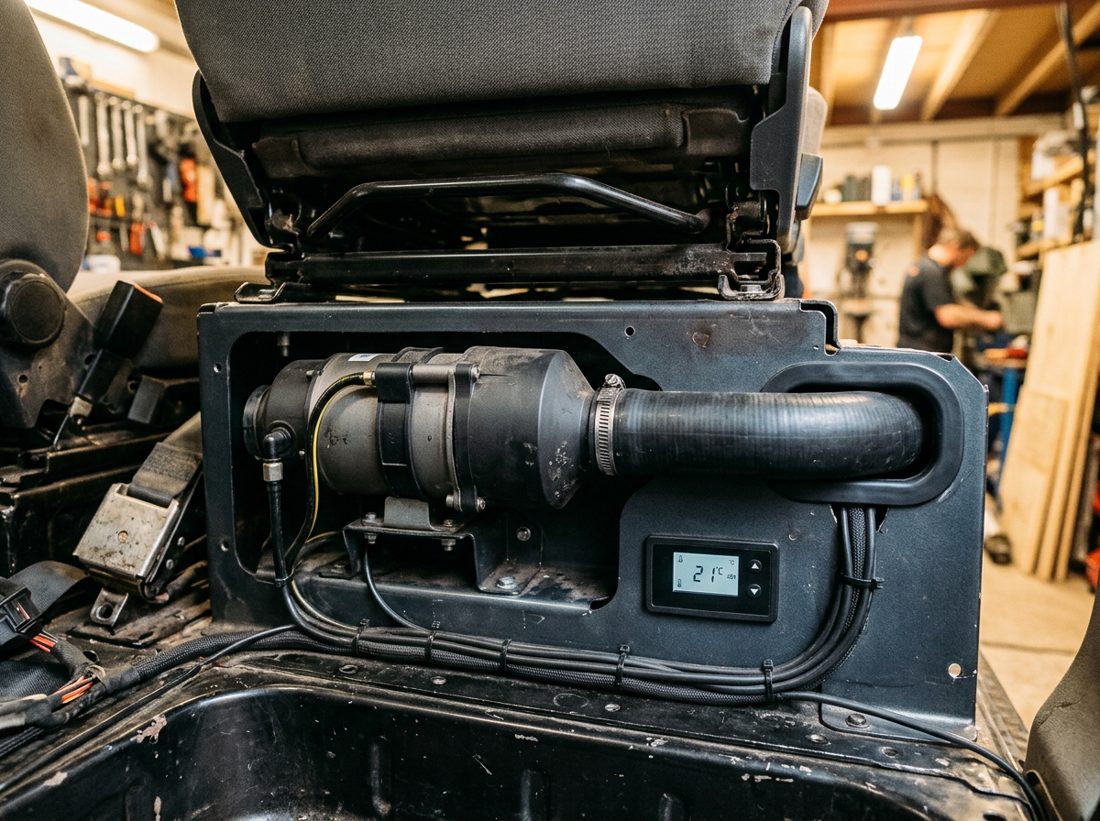
All-in-one (portable) heaters put the heater, fuel tank and controls in one carry box. You stand it on the floor or just outside, and run the exhaust out of the space. They are ideal for garages, tents and trying one out. Kits (split heaters) are fitted under a floor or seat, with the tank, exhaust and air intake outside. That is the tidy, permanent fit for a van or boat, and you'll need ducting and an exhaust kit.
Chinese heaters or Webasto, Eberspacher and Autoterm
Webasto (German) and Eberspacher (German) make the original diesel air heaters used in lorries and motorhomes; Autoterm (formerly Planar, from Latvia) is the third well-known maker. They are mostly sold and fitted through dealers. The low-cost heaters on Amazon (Vevor, Hcalory, LF Bros, Sunster and many others) copy the same design for a fraction of the price. Many owners run them for years; others need a new glow plug, pump or controller sooner. Buy one with lots of reviews, keep the fuel clean and run it on full power for 15 minutes now and then to burn off soot.
Fitting basics
- Exhaust: a sealed, lagged pipe running outside and down, away from doors, windows and the air intake.
- Air intake: draw combustion air from outside, never from inside the space.
- Fuel: a separate tank or a proper standpipe in the vehicle tank, with the pump mounted at an angle as the instructions say.
- Power: a fused feed straight from the battery, thick enough for the start-up current.
- If you are not confident, have a fitter do it. A bad exhaust joint is the main risk.
Safety
Always fit a carbon monoxide alarm in any space with a fuel-burning heater, and never let the exhaust vent into the space you are heating. Diesel air heaters are made for vehicles, boats and outbuildings. Using one to heat a house can affect your insurance and building regulations, so most people stick to garages, sheds and workshops.
Frequently asked questions
What size diesel heater do I need?
2kW for an insulated van, small boat or tent; 5kW for a big or poorly insulated van, a caravan or a single garage; 8kW for a double garage or workshop. The calculator gives a figure for your space.
Are Chinese diesel heaters any good?
They copy the original design for a fraction of the price, and many last for years. Build quality varies, so pick one with plenty of good reviews, fit it well and use a CO alarm.
How much diesel does a diesel heater use?
About 0.1 litres an hour per kW of heat. A 5kW heater at half power uses roughly 0.25 litres an hour.
Will it flatten my battery?
Starting needs 8 to 10 amps for a minute or two; after that most use 1 to 3 amps. A healthy leisure battery runs one overnight. Avoid starting it many times on a weak battery.
Can I use a diesel heater in a tent?
Yes, with an all-in-one heater standing outside or in a porch, and only the warm-air duct going into the tent. Keep the exhaust well away and use a CO alarm. See diesel heaters for tents.